
 SG
SG MY
MY
 HK
HK
 Global
XBRL Filing Timeline: From Financial Year End to ACRA Submission
Introduction
Understanding the XBRL filing timeline Singapore companies need to follow is essential to completing the financial reporting and ACRA submission process accurately and on time. XBRL, eXtensible Business Reporting Language, is a reporting standard that allows for structuring of financial information in a digital format capable of being processed electronically. For companies that are obliged to prepare financial statements in XBRL, the process starts well before the filing deadline, with the financial year-end, followed by the accounting close, financial reporting, audit if applicable, XBRL mapping, validation, and submission. It is therefore important to plan each step ahead to avoid last-minute issues and pressure.
XBRL Filing in Singapore: What Is It?
XBRL is a reporting standard that facilitates the digital presentation of financial information. In contrast to traditional financial statements, XBRL uses tags to identify information. The most common items include revenue, assets, liabilities, equity, expenses, profit or loss, cash flows, share capital, and others, depending on the type of an entity and the applicable reporting requirements. For companies that are obliged to file financial statements with ACRA, the required XBRL format depends on the company's circumstances and filing requirements. XBRL should therefore be viewed as a part of the company's reporting process rather than a separate obligation. The general process involves the following steps:
- Financial year-end
- Accounting close
- Conversion of financial statements
- Audit or review if applicable
- Approval of financial statements
- XBRL Conversion
- XBRL validation
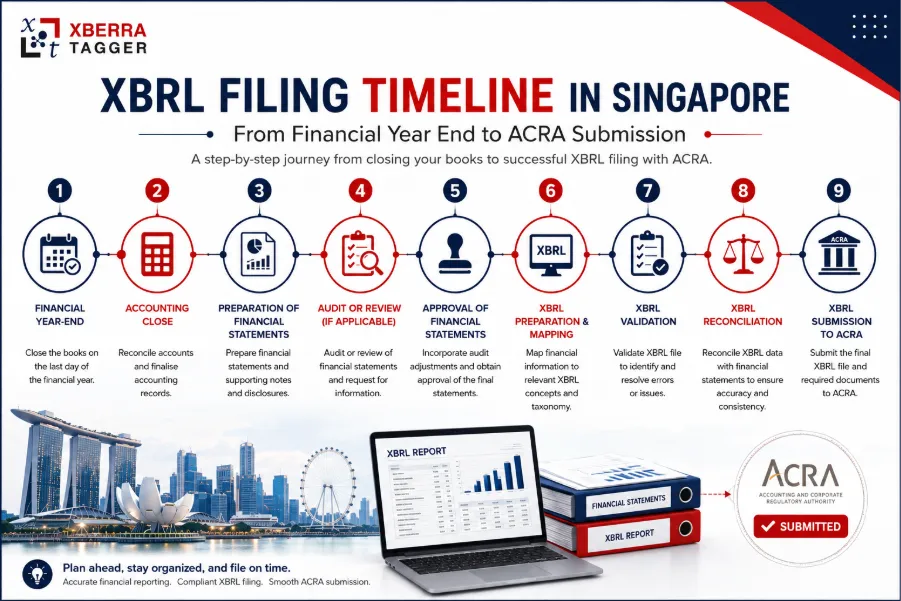
Filing with ACRA The XBRL filing timeline Singapore companies should be aware of starts with the financial year-end. XBRL Filing Timeline: From Year-End to Filing With ACRA
Stage 1: Financial Year-End
The process always starts with the financial year-end. Depending on the company's reporting practices, a company's financial year-end can be on 31 December or another date, depending on the company's reporting practices. For example, a company with a year-end on 31 December will be required to close its books on that date. The finance team will then initiate the year-end close process, which may involve a number of reconciliations, including bank accounts, receivables, payables, accruals, depreciation, inventory, property plant and equipment, financing liabilities, and others. The accuracy of the final statements is of utmost importance, as the final XBRL submission will be based on them. It is therefore essential to have accurate accounting records at all times, rather than waiting for the year-end close to detect discrepancies.
Singapore finance team preparing accounting records and financial statements for XBRL filing

Stage 2: Finalisation of Accounting Records
Once the company completes the year-end close process, the next step is to finalise the accounting records. The finance team may spend some time analysing unusual transactions, year-end adjustments, and balance sheet reconciliations to ensure that all adjustments have been incorporated and that all relevant transactions are captured in the books. Depending on the company's activities, this process can take longer for some entities than for others. Entities that deal with a variety of activities, including foreign exchange, investments, inventory, and complex financing arrangements, may find this process more time-consuming. It is always important to remember that XBRL should be prepared on the basis of substantially finalised accounting information. It is unwise to start XBRL Conversion when the accounting records are still adjusting.
Stage 3: Conversion of Financial Statements
Once the accounting records are finalised, the next step is to prepare the financial statements. Depending on the company's needs and the reporting requirements, the statements may include the statement of financial position, statement of comprehensive income, statement of changes in equity, statement of cash flows, and others, along with supporting notes and policies. The financial statements are the foundation of XBRL reporting, as XBRL generally captures the information included in the statements. It is therefore important to ensure that the financial statements are accu, expenses, assets, liabilities, tax, or equity after XBRL Conversion will require XBRL adjustments.
Stage 4: Audit or Review, if Applicable
For companies that require an audit, the audit process can impact the XBRL filing timeline. Auditors may request various information, including documentation, reconciliation of balances, explanations, and adjustments. It is therefore important to ensure that all adjustments are incorporated in the final financial statements, as they may affect a number of areas, including profit, assets, liabilities, and tax. In general, XBRL Conversion should follow the finalisation of financial statements. One way to plan the XBRL filing timeline is as follows:
- Finalisation of accounting records
- Conversion of financial statements
- Audit, if applicable
- Incorporation of audit adjustments, if applicable
- Approval of financial statements
- XBRL Conversion
Stage 5: Finalisation and Approval of Financial Statements
After the accounting records and audit, if applicable, are finalised, the company should identify the final version of the financial statements that will be used as the basis for XBRL Conversion. Using the final version is essential, as using an earlier version may create inconsistencies between the financial statements and XBRL filing. It is also important to ensure that disclosures, policies, comparative information, and other information included in the financial statements are consistent with the XBRL filing. The finalisation of the financial statements provides a useful starting point for XBRL Conversion.
Stage 6: XBRL Conversion and Mapping
Once the financial statements are finalised, the company can proceed to prepare XBRL and map the relevant information to XBRL concepts. In general, XBRL Conversion is a technical and accounting-intensive process that involves identifying the relevant financial information and XBRL concepts. For example, if the company's financial statements include trade receivables, the preparer will need to identify the applicable XBRL concept for trade receivables. It is important to note that XBRL concepts often require more detailed analysis than simply selecting the concept that matches the label of the financial information. Incorrect XBRL mapping can lead to misrepresentation of the financial information even if the numbers are correct. This is why XBRL Conversion is a technically and accounting-intensive process.
XBRL Conversion and mapping of financial statement data to XBRL concepts

Stage 7: XBRL Validation
After XBRL Conversion, the next step is XBRL validation. In general, XBRL validation helps detect a number of issues, including missing information, incorrect information, calculation errors, incorrect classifications, and other issues. It is important not to leave XBRL validation until the last day, as companies may not have enough time to address the issues detected. In general, companies should conduct XBRL validation at least once before the filing deadline and resolve the issues detected.
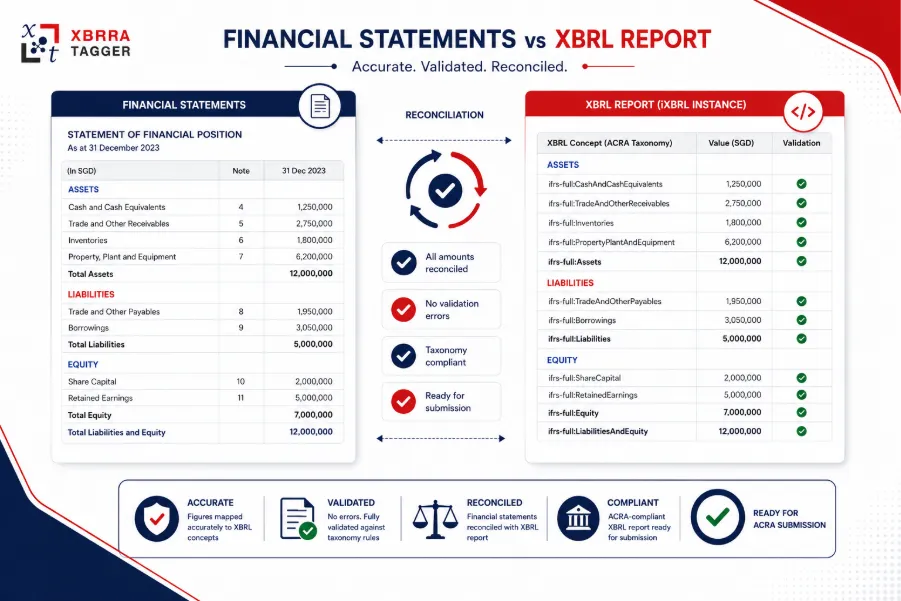
XBRL validation and reconciliation of financial data with financial statements
Stage 8: XBRL Reconciliation with Financial Statements
Another essential step in XBRL Conversion is reconciliation of XBRL with the financial statements. In general, companies should conduct a reconciliation to ensure that the numbers in XBRL match the numbers in the financial statements. It is important to check all numbers, including revenue, profit or loss, assets, liabilities, equity, cash flows, share capital, retained earnings, and comparative information, if applicable. In general, a file may pass validation but include incorrect information that does not match the financial statements. A reconciliation provides an additional level of assurance that XBRL numbers match the numbers in the financial statements.
Stage 9: XBRL Submission to ACRA
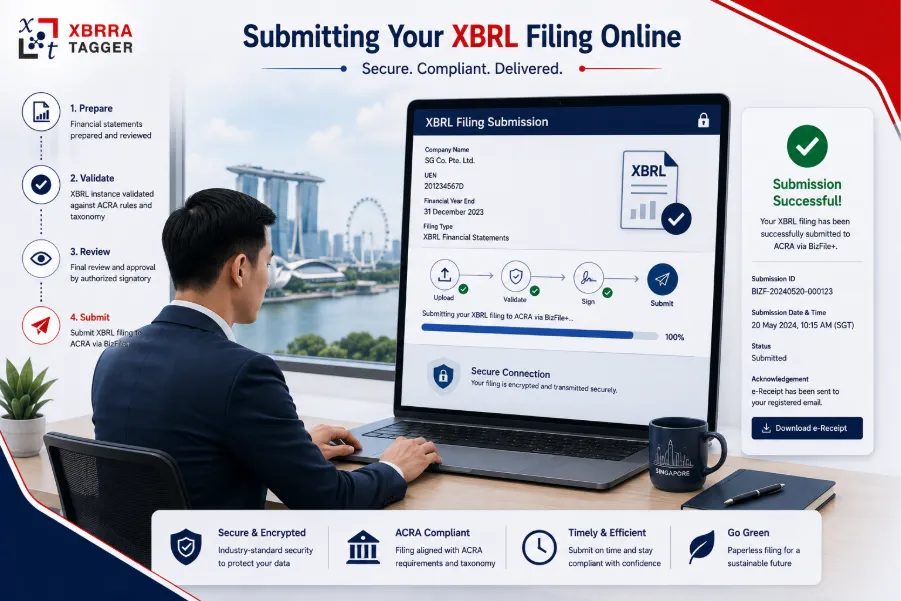
After XBRL Conversion, validation, and reconciliation, the company can proceed to submit XBRL to ACRA. The company should ensure that all required information, including financial information, company information, approvals, and filing authorisations, is available. It is generally a good idea to set an internal submission deadline before the official filing deadline. This way, the company can address any last-minute issues, including technical difficulties or approvals. It is unwise to leave XBRL submission to the last minute, especially when multiple people are involved in the process.
Singapore company submitting XBRL financial information to ACRA online
XBRL Filing Deadline: What Should You Know?
In general, the XBRL filing deadline depends on the company's circumstances and current requirements. It is important to remember that not all companies have the same requirements. For example, some companies may have a year-end on 31 December, while others may have a year-end on another date. In addition, companies may have different requirements in relation to general meetings, including statutory AGM, if applicable, and filing requirements, including XBRL and annual return. It is therefore essential to track the following dates separately:
- Financial year-end
- Statutory AGM, if applicable
- Annual return filing deadline
- XBRL filing deadline
XBRL Filing Mistakes to Avoid
Some of the most common XBRL filing mistakes include leaving XBRL Conversion too late, using incorrect financial statements, incorrect XBRL mapping, and not leaving enough time for XBRL submission. Leaving XBRL Conversion too late can lead to a number of issues, including lack of time to address mapping or validation issues. Using incorrect financial statements is another common issue, as XBRL Conversion should be based on substantially finalised financial statements. If the financial statements change after XBRL Conversion, the XBRL filing will no longer match the financial statements.
Incorrect XBRL mapping is another common issue that can arise when XBRL preparers do not understand the XBRL concepts and taxonomy. As mentioned above, XBRL concepts often require more detailed analysis than simply using the concept that matches the label of the financial information. Another common mistake is not addressing XBRL validation issues. Finally, not leaving enough time for XBRL submission can cause avoidable stress, especially if technical issues or approvals are involved.
How to Make XBRL More Efficient
Companies can make XBRL more efficient by maintaining accurate accounting records and conducting regular reconciliations. Companies can also consider maintaining the information from the previous year's XBRL filing to use as a reference for similar items and disclosures, if applicable. However, it is important to remember that XBRL mapping should always be reviewed on a case-by-case basis. It is also a good idea to implement a review process, where one person prepares XBRL and another person reviews XBRL against the financial statements.
Most importantly, companies should maintain a comprehensive annual compliance calendar that includes the year-end, accounting close, financial reporting, audit, AGM, if applicable, XBRL Conversion and validation, and filing with ACRA.
Conclusion
XBRL filing timeline Singapore companies need to follow is not a one-day process but rather a series of steps that start with the year-end close and end with the XBRL submission to ACRA. Preparing XBRL well in advance can help companies address any discrepancies, mapping issues, and validation errors. A well-planned XBRL filing timeline can therefore make the XBRL process more efficient while helping companies meet their filing obligations.
It is essential to remember that XBRL should be prepared on the basis of substantially finalised financial statements. Companies should always review the latest requirements, filing deadlines, XBRL formats, and exemptions applicable to their company before preparing XBRL and submitting it to ACRA.
FAQs
What is XBRL filing?+
XBRL filing is the process of submitting financial information in a standardized digital format. It makes financial data easy to read, compare, and analyze. It is widely used by regulators worldwide.
When should XBRL Conversion begin?+
XBRL Conversion should begin after the financial statements are finalized. Starting early provides enough time for mapping and validation. This helps avoid filing delays.
Is it possible to prepare XBRL tags before finalizing financial statements?+
Yes, preliminary XBRL tagging can be done before finalization. However, the final tags should always use the approved financial figures. This ensures accuracy and consistency.
What is XBRL mapping?+
XBRL mapping is the process of assigning financial data to the correct XBRL taxonomy tags. It ensures each item is classified properly. Accurate mapping improves reporting quality.
Why is XBRL validation important?+
Validation checks the XBRL file for errors, missing data, and incorrect calculations. It ensures compliance with filing requirements. This reduces the risk of rejection.
Why should XBRL be reconciled with financial statements?+
Reconciliation confirms that XBRL data matches the audited financial statements. It prevents inconsistencies and reporting errors. This improves filing accuracy and reliability.
What are the major reasons for filing errors?+
Filing errors often result from incorrect mapping, missing disclosures, or insufficient validation. Last-minute Conversion also increases mistakes. Proper review helps minimize these issues.
How can firms make XBRL filing more accurate?+
Firms should maintain accurate financial records and perform regular reconciliations. They should validate XBRL files before submission. Early Conversion and careful review improve filing accuracy.
Simplify Your XBRL Filing with XBERRA TAGGER
Make your Singapore XBRL filing process simpler, more accurate, and better organised with XBERRA TAGGER. From XBRL mapping and validation to reconciliation and filing Conversion, get professional support for a smoother filing process.
Ready to simplify your XBRL filing? Visit xberratagger.com.sg today and get started with XBERRA TAGGER, or connect with our filing team NOW! +65 60272438