
 SG
SG MY
MY
 HK
HK
 Global
XBRL & ACRA Glossary: Key Terms Explained A–Z

Introduction
Whenever you have prepared financial statements for submission to Singapore's Accounting and Corporate Regulatory Authority (ACRA), you have probably encountered technical terms such as XBRL, taxonomy, BizFinx, and validation errors. Although these terms are commonplace in the context of statutory reporting, they can still be confusing—particularly if you are preparing an XBRL filing for the first time or if you are handling multiple client submissions.
The guide consisting of XBRL glossary terms from ACRA is intended to explain the most frequently used terminology in Singapore's digital financial reporting environment; instead of giving textbook-style definitions, it provides practical explanations which accountants can use in their day-to-day filing tasks.
This glossary is a useful reference at every stage of the XBRL Conversion process, whether you are drawing up financial statements for one company or dealing with statutory filings for a number of clients.
Why Understanding XBRL Terms Matters
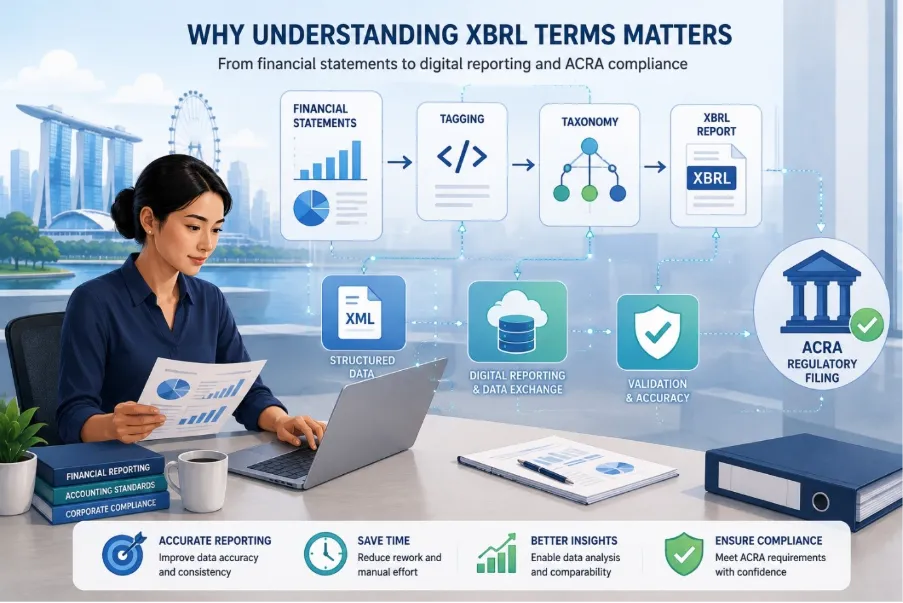
XBRL & ACRA Glossary: Key Terms Explained A–Z
A – ACRA
The Accounting and Corporate Regulatory Authority (ACRA) is the national regulatory body of Singapore and has responsibility for company registration, corporate compliance, and for statutory financial reporting.
For companies which have to file their financial statements in XBRL format, ACRA lays down the rules concerning filing, the reporting standards and the method of submission. The first step in preparing financial statements that comply with the requirements is to understand these rules.
A – Annual Return
An Annual Return is a statutory document which must be submitted to ACRA and includes important information about the company, such as details concerning financial reporting.
Even though the Annual Return is a document separate from the financial statements, the two should still be consistent. The company details, the financial year-end, and the reporting information must always agree in order to prevent unnecessary queries when filing or compliance problems.
B – BizFinx
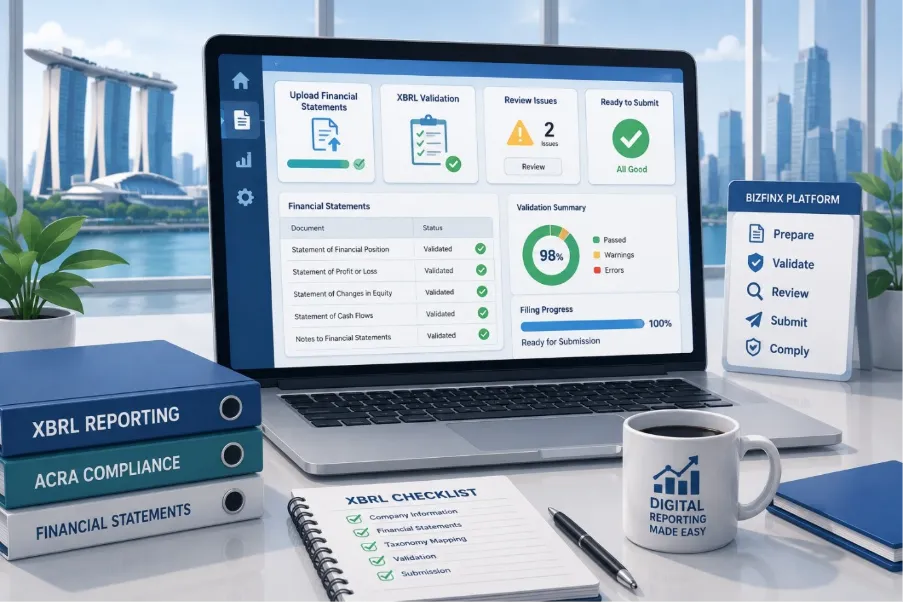
BizFinx is the platform that ACRA uses for preparing and submitting XBRL financial statements. Before the submission, the platform checks the financial information and points out any technical problems that need to be addressed. Although the financial statements are correct, BizFinx could still detect missing required fields,
inconsistencies in the calculations, or formatting problems that have to be sorted out before the filing is carried out. If accountants understand how BizFinx works they will be able to pick up on any problems early rather than having to address them near the statutory deadline.
C – Concept
A concept is an individual item in the XBRL taxonomy relating to reporting.
Examples include:
- Revenue
- Cash and Cash Equivalents
- Trade Receivables
- Share Capital
- Retained Earnings
In any XBRL filing each amount had to be linked to the appropriate concept. Choosing the correct concept makes it possible for regulators, financial institutions, and reporting systems to interpret the financial information accurately.
D – Data Element
A data element is a single item of information that is included in an XBRL report.
Examples include:
- Monetary values
- Company registration details
- Financial year-end
- Accounting policy disclosures
- Director information
Even though each individual data element may seem small on its own, hundreds or even thousands of them combined produce a structured financial report which software can automatically process.
F – Financial Statements
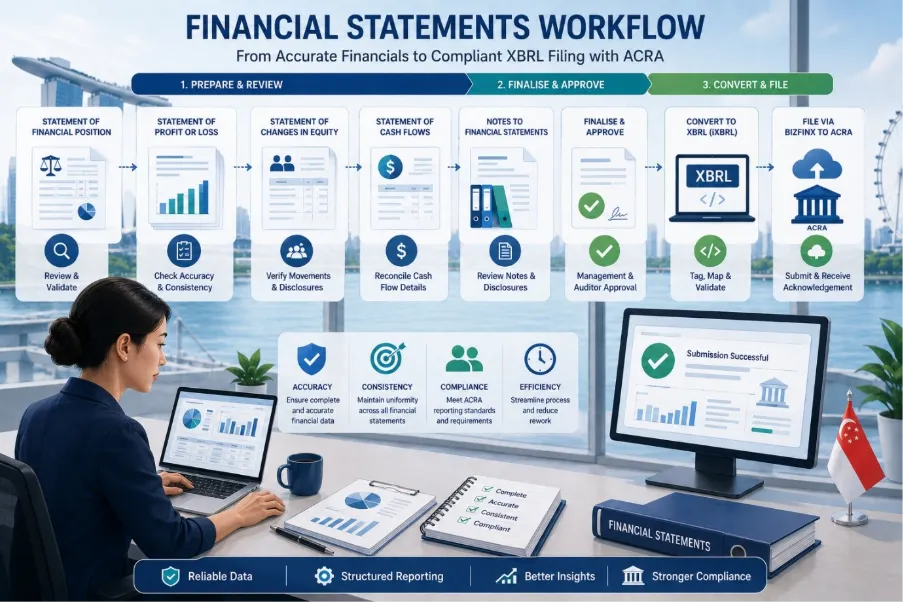
The financial statements are the basis of all XBRL filings.
These generally include:
- Statement of Financial Position
- Statement of Profit or Loss
- Statement of Changes in Equity
- Statement of Cash Flows
- Notes to the Financial Statements
Before embarking on the XBRL Conversion, accountants must make sure that the financial statements have been completely approved and finalised. If any alterations are made after tagging has started, then several sections of the filing will have to be checked once more, which in turn increases both the time and the effort required.
F – Filing Requirements
It is not the case that all companies in Singapore have the same XBRL filing obligations.
Depending on eligibility, companies may submit:
- Full XBRL Financial Statements
- Simplified XBRL Financial Statements
- Alternative filing formats permitted by ACRA
Checking that the correct filing requirement is confirmed before starting the Conversion process will help prevent unnecessary rework and makes sure that the right reporting format is chosen from the beginning.
I – Inline XBRL (iXBRL)
Inline XBRL (iXBRL) incorporates machine-readable XBRL tags together with human-readable financial statements into one document.
This is unlike the case with traditional XBRL files, which primarily contain structured reporting data, since iXBRL enables users to read the financial statements while software at the same time processes the embedded tags.
Accessibility is being improved by many regulators all over the world through the use of iXBRL, without any sacrifice to data quality.
M – Mandatory Fields
The fields that are mandatory have to be filled in order for an XBRL filing to pass the system validation successfully.
Examples include:
- Company Name
- Unique Entity Number (UEN)
- Reporting Period
- Reporting Currency
- Required Financial Statement Disclosures
If any of the required fields are left incomplete, the system will display validation message and the submission will be delayed. Checking these fields at an early stage will help reduce the need for last-minute changes.
M – Mapping
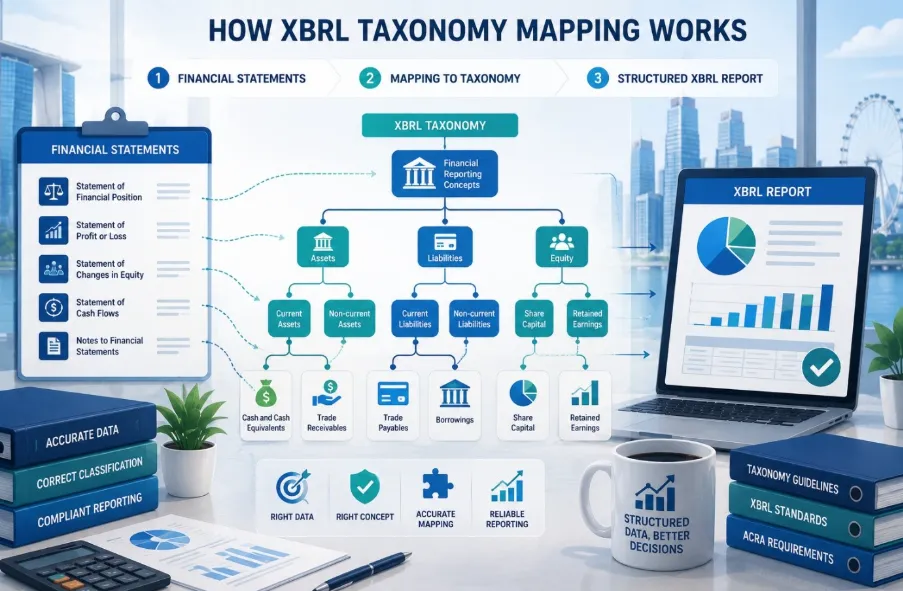
Mapping involves assigning the information from financial statements to the appropriate concepts in the XBRL taxonomy.
Even though software offers guidance, accountants still use their professional judgement to decide on the most suitable reporting concept.
For instance, two accounts might look similar but would need different taxonomy classifications according to how they are accounted for. Proper mapping enhances the quality of reporting and lowers the risk of errors when filing.
How XBRL Taxonomy Mapping Works
M – Metadata
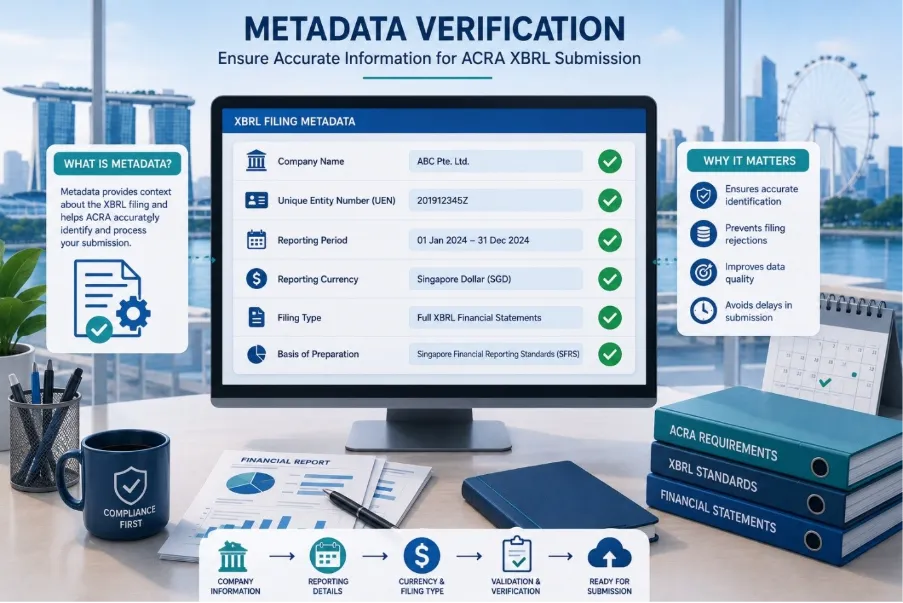
Metadata is background information that describes the XBRL filing, not the financial figures themselves.
Typical metadata includes:
- Company Name
- Unique Entity Number (UEN)
- Reporting Period
- Reporting Currency
- Filing Type
The financial statements might be accurate, but wrong metadata can still lead to filing problems that are avoidable. Accountants should check before submitting that all the company details agree with those in ACRA's official records.
N – Notes to Financial Statements
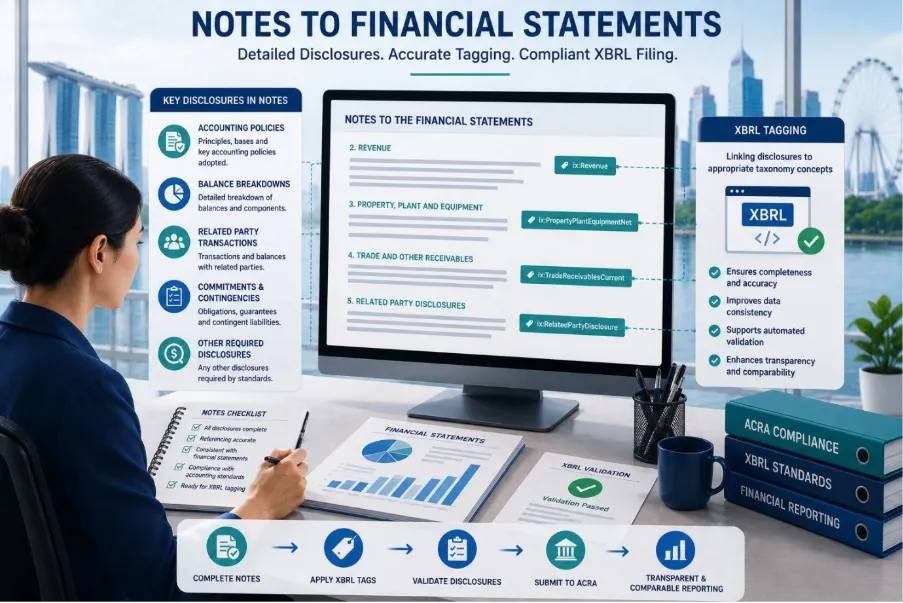
The explanations given in the Notes to the Financial Statements are the detailed reasons for the figures found in the main financial statements and cover the accounting policies, the breakdowns of the balances, the commitments, the contingencies, the related-party transactions, and all other disclosures required by the relevant accounting standards.
The notes in an XBRL filing are just as important as the financial statements themselves, since omitted or incorrectly tagged disclosures may cause validation problems or lead to an incomplete submission. Before starting the process of tagging, accountants must make sure that the notes are final, have been approved, and are completely consistent with the other parts of the financial statements.
R – Reporting Period
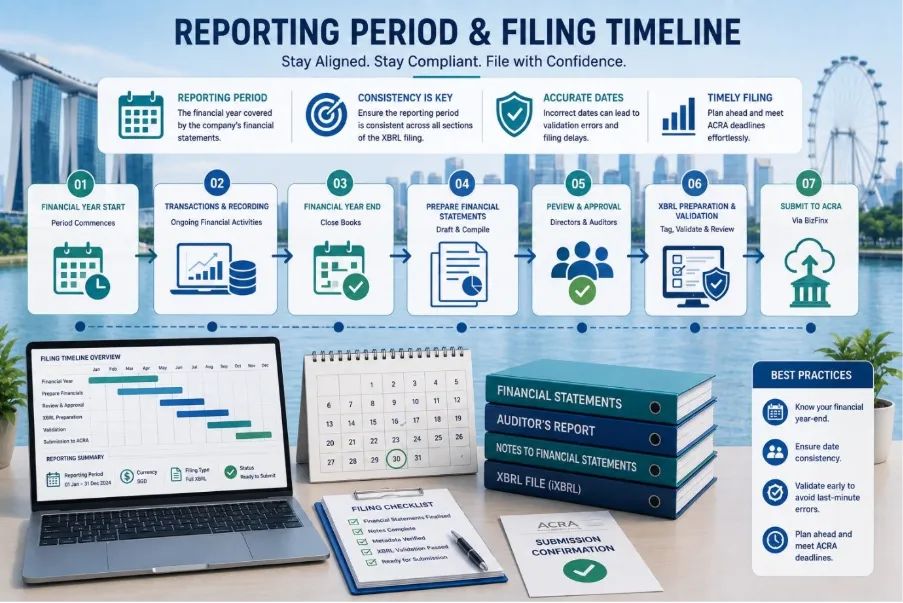
The financial year covered by the company's financial statements is known as the reporting period.
In any XBRL filing, whether it involves company information or comparative figures, the reporting period should be the same across all sections. If the financial year-end is wrong or the report dates are inconsistent, it results in a number of unnecessary validation messages and delays the filing process.
When you submit the report, make sure the reporting period agrees with the company's official financial statements and its ACRA filing records.
S – Simplified XBRL
Simplified XBRL is a format that eligible companies in Singapore can use when filing.
Rather than including all the disclosures present in a Full XBRL filing, Simplified XBRL centres on a specific set of financial information required by ACRA. Companies must check that they are eligible before choosing this filing option.
Understanding the reporting requirements that apply before preparing the financial statements is important, since using the incorrect filing format could lead to unnecessary revisions.
S – Source Document
The final version of the financial statements used in preparing an XBRL filing is the source document.
Ideally, it should include:
- Approved Financial Statements
- Directors' Statement
- Auditor's Report (where applicable)
- Complete Notes to the Financial Statements
It is common for preparing XBRL reports based on draft financial statements to result in a lot of unnecessary reworks since even minor accounting changes can have an impact on a number of the tagged items in the report. By using the final approved version alone it is possible to guarantee consistency and avoid delays when filing.
T – Tagging
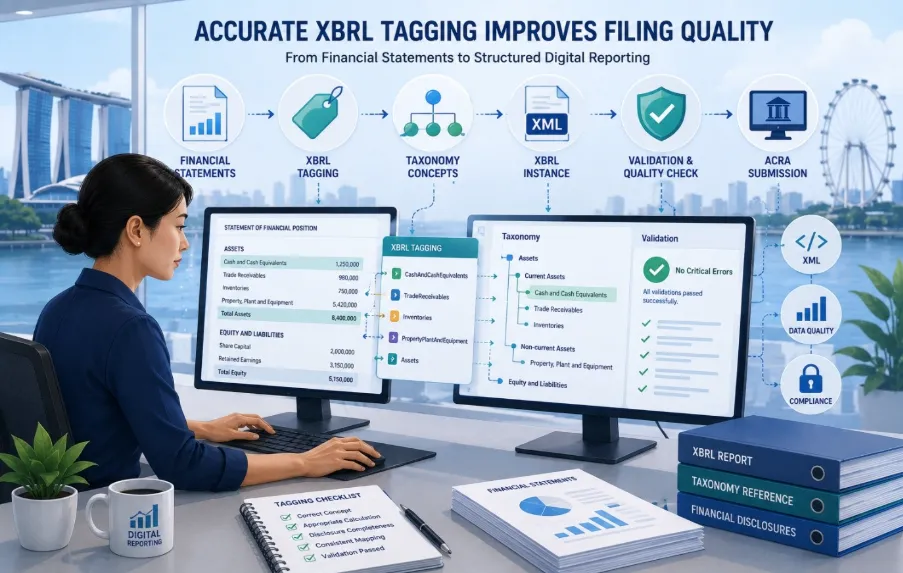
Tagging involves giving financial statement information XBRL labels.
Each balance, each disclosure, and each note is connected to a particular taxonomy concept in order that computer systems may correctly interpret and analyse the financial information.
Success in tagging depends on having both technical expertise and sound accounting judgement; although choosing the wrong tag doesn't always result in a validation error it can lower the accuracy and reliability of the financial data that is reported.
T – Taxonomy
A taxonomy is the structured dictionary employed in XBRL reporting.
It includes thousands of reporting concepts together with their definitions, relationships, calculation rules, and the way they are presented.
When preparing financial statements for ACRA, accountants use the taxonomy to decide how the financial information should be categorised and presented. Selecting the right taxonomy concepts is one of the most important stages in preparing an accurate and compliant XBRL filing.
V – Validation Errors
Review Validation Errors Before Submission
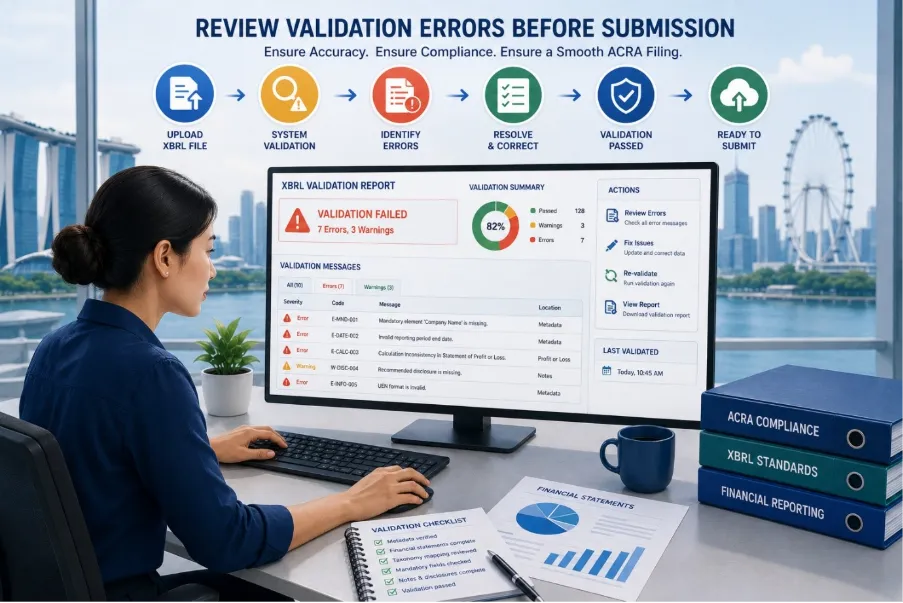
A validation error occurs when the XBRL filing system picks up missing information or technical inconsistencies.
Some of the most common validation errors include:
- Missing mandatory disclosures
- Incorrect reporting dates
- Calculation inconsistencies
- Invalid company information
- Incomplete financial statement sections
Instead of delaying validation until the final stage of the filing process, accountants should deal with these problems as early as possible. When one validation error is corrected, several related messages are often cleared, which makes the reviewing process more efficient.
X – XML

XML, also known as eXtensible Markup Language, is the technology which forms the basis of XBRL reporting.
Accountants usually do not work directly with XML code, since it allows financial information to be stored in a structured format which can be read by software applications and exchanged between different systems.
It is not necessary to understand XML in order to prepare financial statements, but if you know its role then you can see why XBRL data can be automatically processed by regulators, financial institutions, and reporting platforms.
X – XBRL
XBRL, or eXtensible Business Reporting Language, is the international standard for digital business reporting.
It turns traditional financial statements into structured electronic data so that financial information can be more easily analysed, compared, and exchanged electronically.
For Singaporean companies, XBRL enhances ACRA's digital reporting framework by improving the consistency of the reports, cutting down on the amount of manual processing, and allowing for a quicker regulatory review.

Conclusion
Preparing financial statements for ACRA is no longer just an accounting exercise. it also requires a clear understanding of digital reporting concepts. From taxonomy and tagging to metadata, validation errors, and BizFinx, every term plays a role in producing an accurate XBRL filing.
Frequently Asked Questions
What is an XBRL glossary, and why is it important?+
An XBRL glossary explains the technical terms used in digital financial reporting. Understanding these terms helps accountants, finance teams, and corporate secretaries prepare accurate XBRL filings and avoid common submission errors with ACRA.
What is the role of ACRA in XBRL filing?+
ACRA regulates corporate reporting in Singapore and requires eligible companies to submit financial statements in XBRL format. It also sets the filing requirements, reporting standards, and validation rules for statutory submissions.
What is BizFinx used for?+
BizFinx is ACRA's platform for preparing and validating XBRL financial statements. It helps identify missing mandatory fields, calculation inconsistencies, and technical errors before submission.
What is XBRL taxonomy?+
An XBRL taxonomy is a structured dictionary of reporting concepts used to classify financial information. Selecting the correct taxonomy ensures that financial data is accurately interpreted by ACRA and other reporting systems.
Why is XBRL tagging important?+
XBRL tagging links each financial figure and disclosure to the appropriate taxonomy concept. Proper tagging improves reporting accuracy, supports automated validation, and reduces the risk of filing errors.
What are the most common XBRL validation errors?+
Common validation errors include missing mandatory disclosures, incorrect reporting periods, calculation inconsistencies, invalid company details, and incomplete financial statement sections. Reviewing these issues before submission helps avoid delays.
Can companies submit Simplified XBRL instead of Full XBRL?+
Some companies may qualify for Simplified XBRL based on ACRA's filing requirements. Businesses should confirm their eligibility before preparing financial statements to ensure the correct filing format is used.
How can Xberra Tagger help with ACRA XBRL filing?+
Xberra Tagger provides end-to-end XBRL conversion, taxonomy mapping, validation support, and filing assistance for Singapore companies. Our experts help ensure your financial statements meet ACRA's requirements for an accurate and compliant submission.
Need Expert Support for ACRA XBRL Filing?
Preparing an accurate XBRL filing requires more than converting financial statements—it demands correct taxonomy mapping, validation checks, and compliance with ACRA's reporting requirements. Xberra Tagger Singapore helps accountants, corporate secretaries, and businesses streamline the entire filing process with accurate XBRL conversion and professional filing support.
Contact Xberra Tagger today to simplify your ACRA XBRL filing and submit your financial statements with confidence.