
 SG
SG MY
MY
 HK
HK
 Global
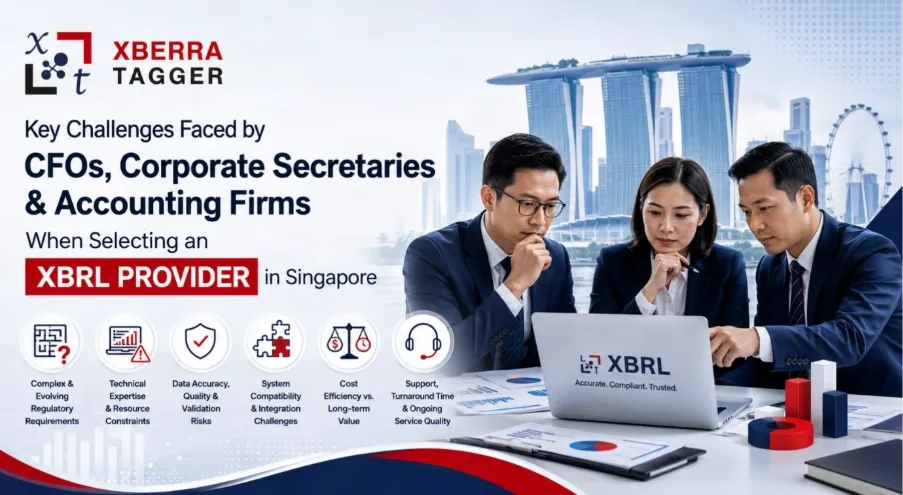
Key Challenges Faced by CFOs, Corporate Secretaries & Accounting Firms When Selecting an XBRL Provider in Singapore
Understanding Why Choosing the Right XBRL Partner Matters in Singapore
As Singapore's corporate reporting ecosystem continues evolving through ACRA and BizFinx 4, businesses are under increasing pressure to ensure accurate, compliant, and timely XBRL submissions.
For many organizations, XBRL filing is no longer just a year-end compliance activity. It has become a critical operational process tied directly to:
- Regulatory compliance
- Filing efficiency
- Audit coordination
- Corporate governance
- Client servicing
For CFOs, Corporate Secretarial firms, and Accounting Firms, selecting the wrong XBRL provider can lead to:
- Filing rejection
- Validation failures
- Delayed submissions
- Repeated revisions
- Increased operational workload
- Client dissatisfaction
Many businesses initially assume XBRL filing is simply converting financial statements into XML format. In reality, Singapore XBRL filing requires strong accounting knowledge, taxonomy expertise, BizFinx familiarity, and understanding of ACRA filing requirements.
This is why selecting the right XBRL provider has become increasingly important for businesses and professional firms across Singapore.
Understanding ACRA XBRL Filing & BizFinx 4
The Accounting and Corporate Regulatory Authority (ACRA) introduced XBRL filing to standardize digital financial reporting across Singapore companies.
Through the BizFinx ecosystem, companies can prepare and submit:
- Full XBRL filings
- Simplified XBRL filings
- Financial statements
- Structured disclosure information
With the evolution toward BizFinx 4, the filing framework introduced:
- Enhanced validation systems
- Updated taxonomy structures
- Improved filing workflows
- Better data consistency checks
- More structured reporting requirements
As a result, businesses today face greater technical and operational complexity when preparing XBRL filings.
1. Difficulty Finding Providers with Genuine ACRA & BizFinx Expertise
One of the biggest challenges businesses faces is identifying providers who truly understand Singapore's XBRL filing ecosystem.
Many vendors offer generic XML conversion services but lack:
- Practical ACRA filing experience
- BizFinx workflow knowledge
- Understanding of Singapore taxonomy structures
- Experience handling Full XBRL disclosures
This creates significant risks during filing Conversion and validation stages.
The challenge becomes even more complex for:
- Holding companies
- Multi-subsidiary groups
- Financial services firms
- Companies with detailed disclosures
- Large enterprises
Businesses increasingly prefer providers with strong Singapore-focused filing expertise rather than generic offshore XML processing support.
2. Full XBRL Financial Mapping Is More Complex Than Expected
One of the most underestimated aspects of Singapore XBRL filing is financial statement mapping.
The real complexity lies in:
- Notes to accounts tagging
- Taxonomy alignment
- Disclosure interpretation
- Consolidated financial statements
- Validation consistency
- Industry-specific reporting structures
Incorrect mapping can result in:
- Filing rejection
- Validation errors
- Repeated revision cycles
- Delayed statutory compliance
This is why accounting knowledge plays a critical role in successful XBRL conversion and filing.
3. Accounting Firms Need Providers That Can Handle Bulk Filings Efficiently
Accounting firms and Corporate Secretarial firms in Singapore often manage large filing volumes during annual filing seasons.
A major challenge is that many providers struggle to scale operationally.
This often leads to:
- Delayed turnaround
- Revision bottlenecks
- Slow communication
- Resource shortages
- Filing delays
Professional firms increasingly seek providers capable of supporting:
- Bulk XBRL conversion
- Structured workflows
- Dedicated support teams
- White-label partnerships
- High-volume filing operations
Operational reliability has become just as important as technical expertise.
4. BizFinx 4 Validation Errors Continue to Create Filing Challenges
BizFinx 4 introduced more advanced validation systems and stricter filing structures.
Many organizations continue facing issues such as:
- Taxonomy mismatches
- Mandatory disclosure errors
- Validation inconsistencies
- Data formatting issues
- Upload and submission failures
Without experienced support, resolving these issues can consume significant internal time and resources.
Reducing validation failures has become one of the key reasons businesses carefully evaluate XBRL providers before outsourcing filing work.
5. Lack of Transparent Pricing Creates Operational Challenges
Pricing transparency remains a major concern for many accounting firms and businesses outsourcing XBRL filing.
Some vendors charge additional fees for:
- Notes tagging
- Validation corrections
- Urgent filing requests
- Financial statement revisions
- Complex disclosure handling
This creates budgeting uncertainty for firms managing recurring or bulk filings.
Organizations increasingly prefer providers offering:
- Clear pricing structures
- Defined scope of work
- Transparent revision policies
- Predictable turnaround expectations
6. Data Security & Confidentiality Expectations Continue to Increase
Financial statements contain highly confidential corporate information.
Businesses now expect XBRL providers to maintain:
- Secure file handling
- Confidential workflows
- NDA-backed operations
- Controlled access management
- Secure document transfer systems
This is especially important for:
- Listed companies
- Audit firms
- Financial institutions
- Multi-national organizations
- Large corporate groups
Data security has become a major vendor evaluation factor in Singapore's compliance outsourcing ecosystem.
7. Businesses Want Future-Ready Digital Reporting Partners
Singapore continues moving toward broader digital compliance ecosystems involving:
- ESG reporting
- Sustainability disclosures
- Structured reporting frameworks
- Automated regulatory reporting
- Digital finance transformation
Businesses increasingly prefer providers who understand the future direction of regulatory reporting rather than simply offering basic XML conversion services.
Future-ready providers help organizations stay prepared for evolving compliance requirements.
How Experienced XBRL Providers Help Reduce Filing Risks
Experienced XBRL providers help businesses by:
- Improving filing accuracy
- Reducing validation failures
- Supporting faster turnaround
- Managing bulk filing operations
- Handling complex disclosures efficiently
- Improving operational coordination
For accounting firms and Corp Sec firms managing multiple clients, reliability and responsiveness are critical.
Platforms like Xberra Tagger support businesses and professional firms across Singapore through structured XBRL workflows, dedicated support, scalable filing operations, and BizFinx-focused expertise.
Final Thoughts
As ACRA and BizFinx 4 continue reshaping Singapore's digital reporting environment, selecting the right XBRL provider has become an increasingly important business decision for CFOs, Accounting Firms, and Corporate Secretarial firms.
The ideal provider should offer:
- Strong ACRA expertise
- Accurate financial mapping
- BizFinx familiarity
- Operational scalability
- Responsive support
- Future digital reporting readiness
Choosing the right XBRL partner ultimately helps businesses reduce compliance risks while improving filing efficiency, operational confidence, and long-term reporting readiness.
Connect with our Expert Team NOW! +65 60272438
FAQs
What is XBRL filing in Singapore?+
XBRL filing in Singapore refers to the submission of financial statements in structured digital format to ACRA through the BizFinx filing framework.
What is BizFinx 4?+
BizFinx 4 is the updated filing ecosystem used for preparing and validating XBRL submissions in Singapore with enhanced workflows and validation systems.
Why do Singapore XBRL filings get rejected?+
Common reasons include incorrect taxonomy mapping, validation failures, mandatory disclosure issues, and data formatting inconsistencies.
Why should accounting firms outsource XBRL filing?+
Outsourcing helps accounting firms manage high filing volumes efficiently while reducing operational workload, validation risks, and turnaround pressure.
What should businesses look for in a Singapore XBRL provider?+
Businesses should evaluate ACRA expertise, BizFinx experience, financial mapping capability, turnaround efficiency, support quality, scalability, and pricing transparency.